Shifts and business day
A shift that opens with a float and closes with a count — and a day that closes on a manager's decision.
The MENUVA till takes no sale without an open shift. A shift opens with a declared cash float and closes with a count of expected against counted, and any difference needs a reason. The business day has a cutoff you set, and the owner or a branch manager closes it.
What happens today
The cashier starts with no recorded float, and late at night a difference appears in the drawer that nobody can explain. Sales at one in the morning land on the wrong day.
What changes with MENUVA
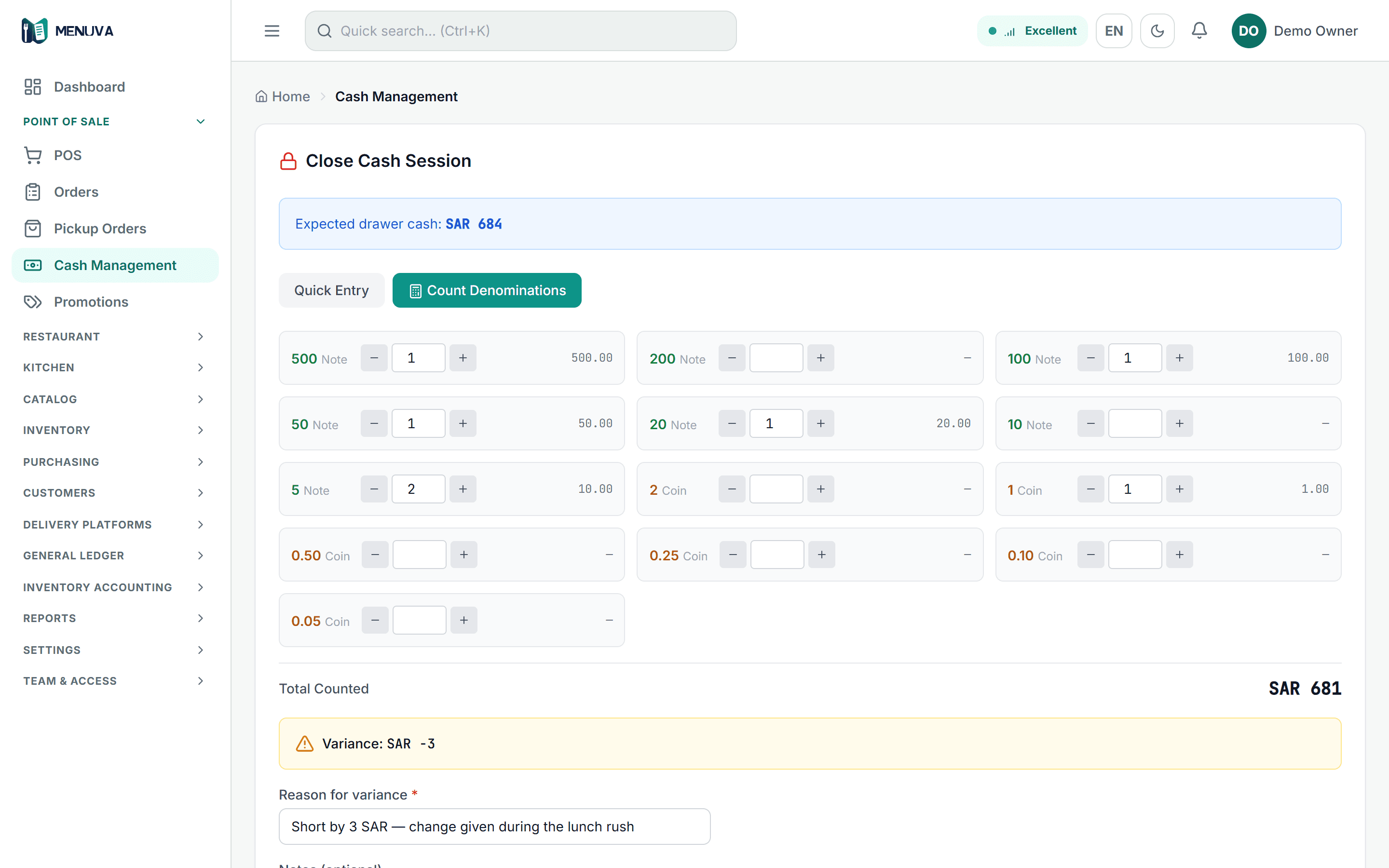
Opening a shift requires an explicit float — and zero needs a confirmation that is recorded. Closing counts the cash by denomination; the difference is calculated automatically and not accepted without a reason; a manager approves or rejects it; and a closing report is produced. Cash in and out is recorded. The business day has a cutoff in the restaurant's time zone, and closing it is a separate permission a cashier does not hold — never while a shift is open.
POS flow
From opening the shift to the journal entry
01Open the shift
With a declared cash float.
Leaves: Shift open
02The sale
Dine-in, takeaway or delivery; price and VAT from the server.
03Payment
Cash, card or transfer, or split.
Leaves: Paid
04The kitchen
The ticket on the kitchen screen, longest-waiting first.
05Accounting
Revenue, VAT and cost of sales post automatically.
Leaves: Posted
And at close: a cash count, with a manager-approved reason for any difference.
Every riyal in the drawer has an explanation, and every day closes on its own figures.
No sale outside a shift.
A cash difference without a reason is not accepted.
After-midnight sales land on the right day.
What it covers
- A shift for every sale
- Without an open shift there is no sale or payment at the till.
- An explicit opening float
- A blank is not zero, and zero needs a confirmation.
- Close with a count
- Count by denomination, expected against counted.
- A reason and an approval
- The server enforces the reason; a manager approves or rejects.
- A business-day cutoff
- After-midnight sales on their own day.
- End of day by permission
- For the owner and branch manager, with an overdue reminder.
Part of the same workflow
- Point of sale →A touch till that sells inside an open shift: dine-in, takeaway and delivery from one screen, prices and VAT calculated by the server, and payment by cash, card or transfer — or split between them.
- Reports →Reports are built from the same data the restaurant runs on: sales by shift, day and branch, best sellers with their margin, peak hours, stock movement and value, and the financial statements.
- Accounting →Every paid sale in MENUVA posts its double-entry journal automatically — revenue, VAT and cost of sales — and so do purchase receipts, transfers, count differences, waste and refunds. The financial statements and the VAT summary are built from those entries.
How do shifts and business days work?
The till takes no sale without an open shift, and a shift opens with a declared cash float and closes with a count of expected against counted.
Any cash difference needs a reason, which the server enforces, and a manager approves or rejects it. The business day has a cutoff you set, so after-midnight sales land on the right day. The day is closed by the owner or a branch manager — not a cashier — never while a shift is open, and never automatically.
Every MENUVA answer →Try it on your restaurant.
14 days free, with no bank card.