Team and permissions
Every employee sees only what they need.
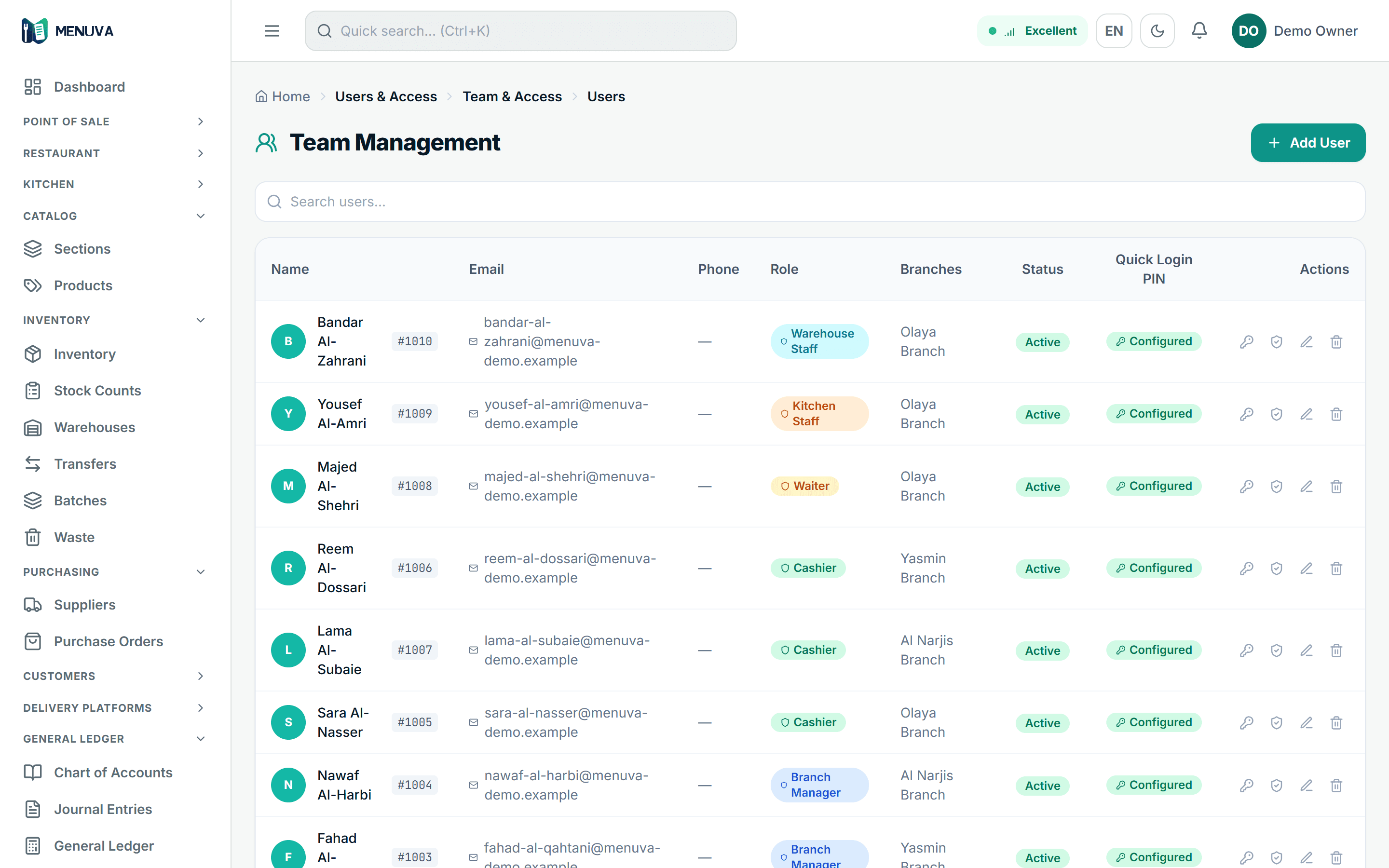
Each employee gets an account and a role — owner, branch manager, cashier, waiter, kitchen, store, accountant — or a custom role with fine-grained permissions, a 4–6 digit quick PIN, and an audit log that cannot be edited.
What happens today
One account everyone uses and a password the whole team knows. You cannot say who gave the discount or voided the invoice, and the cashier can open reports and costs.
What changes with MENUVA
Each employee gets their own account and role: cashier, waiter, kitchen, store, accountant, manager. The role decides what they see and can do; the branch decides which data reaches them. For speed during a shift, staff sign in with a 4–6 digit PIN instead of typing a long password at the till.
Multi-branch flow
From the company to one view of every branch
01The company
One account and one set of books.
02Branches
Each branch with its own stock and orders.
03Users and permissions
Staff tied to their branch; the server refuses the rest.
04Warehouses
A central warehouse supplying by documented transfers, never billed as a branch.
Leaves: In transit
05Consolidated visibility
Management sees and compares every branch; the company total is a report, not a place.
Clear accountability on every action, and a shift that keeps moving.
You know who gave the discount and who voided the invoice.
The cashier does not see costs or reports.
A quick sign-in that does not slow the shift.
What it covers
- Ready roles
- Cashier, waiter, kitchen, store, accountant, manager.
- Quick PIN login
- 4 to 6 digits, and never shown again after it is set.
- Permission per action
- Discounts, voids and returns are each governed.
- Tied to a branch
- An employee sees their own branch's data only.
Part of the same workflow
- Branches →Every branch sits in one account with its own stock, staff and orders. The server keeps an employee out of other branches' data, and management sees every branch and compares them.
- Point of sale →A touch till that sells inside an open shift: dine-in, takeaway and delivery from one screen, prices and VAT calculated by the server, and payment by cash, card or transfer — or split between them.
- Reports →Reports are built from the same data the restaurant runs on: sales by shift, day and branch, best sellers with their margin, peak hours, stock movement and value, and the financial statements.
How does multi-branch management work?
Every branch sits in one account with its own stock, staff and orders, and an employee is tied to their branch and cannot reach another branch's data.
The refusal happens on the server, not by hiding buttons. A central warehouse is a stock location separate from the branches and is never billed as one, and goods move by a documented transfer: request, approval, dispatch, in transit, then receipt. Management sees every branch and compares them.
Every MENUVA answer →Try it on your restaurant.
14 days free, with no bank card.